In healthcare, the greatest workplace risks are not always the ones making headlines. A missing training record, an overfilled sharps container, an unlabeled disinfectant bottle, or an expired respirator fit test can expose employees to serious harm and leave an organization vulnerable during an inspection.
When I evaluate OSHA compliance requirements for healthcare facilities, I look beyond whether policies merely exist. I focus on whether employees understand them, supervisors enforce them, and the facility can prove compliance through current records.
From bloodborne pathogens and hazardous chemicals to radiation, workplace violence, and patient-handling injuries, every overlooked hazard can affect both worker safety and continuity of care.
Which OSHA standards apply to healthcare facilities?
Commonly relevant standards cover bloodborne pathogens, hazard communication, PPE, respiratory protection, ionizing radiation, electrical safety, emergency planning, fire protection, and walking-working surfaces. OSHA’s General Duty Clause also requires employers to address recognized serious hazards even when no hazard-specific standard exists.
State Plans must be at least as effective as federal OSHA and may impose additional requirements.
How should facilities prevent bloodborne pathogen exposure?
Under 29 CFR 1910.1030, employers whose workers may contact blood or other potentially infectious materials need a written Exposure Control Plan and must review it at least annually. It should address safer devices, including needleless systems and self-sheathing needles, universal precautions, and safe work practices.
Employers must provide suitable PPE, maintain proper housekeeping procedures, and place contaminated sharps in closable, puncture-resistant, leak-resistant, labeled or color-coded containers.
They must offer the hepatitis B vaccination series at no cost to eligible workers after training and within 10 working days of initial assignment. Post-exposure evaluation and follow-up must also be available.
What does Hazard Communication require in healthcare?
The Hazard Communication Standard, 29 CFR 1910.1200, applies when employees may encounter hazardous chemicals such as sterilants, disinfectants, laboratory reagents, and certain chemotherapy drugs.
Facilities should maintain a written program, current chemical inventory, accessible Safety Data Sheets, and correctly labeled containers using the Globally Harmonized System.
Training should cover chemical hazards, storage, handling, PPE, and spill response. Employees must have access to safety information during their shift.
What PPE and respiratory protection must employers provide?
Under 29 CFR 1910.132, employers must assess hazards and select suitable gloves, gowns, masks, eye protection, and face shields. Required PPE generally must be provided at no cost and kept sanitary and reliable through inspection, cleaning, replacement, or proper disposal.
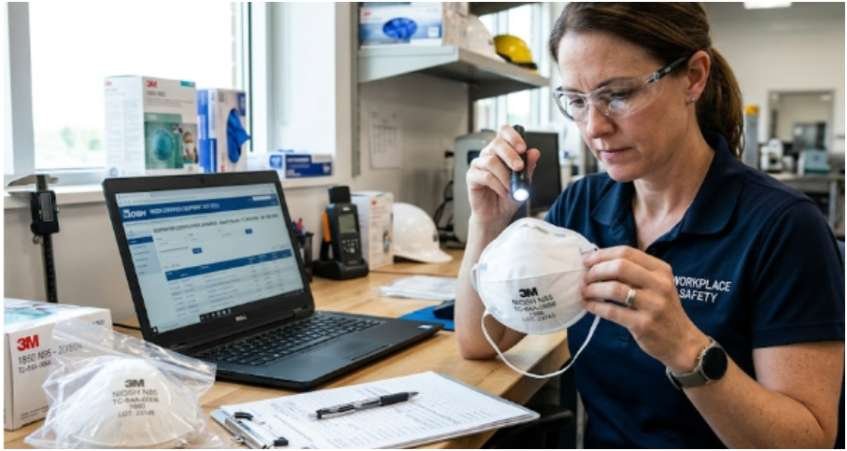
When workers must wear tight-fitting respirators such as N95s, the Respiratory Protection Standard may require a written program, medical evaluation, initial and annual fit testing, training, maintenance, and safe storage. Medical evaluation must occur before fit testing, and workers should perform a user seal check whenever they wear one.
How should healthcare facilities control radiation and equipment risks?

Facilities using X-ray systems, CT scanners, or other ionizing radiation sources should assess exposure, restrict controlled areas, post warning signs, maintain safeguards, and issue dosimetry badges when monitoring requirements apply.
Medical lasers involve non-ionizing radiation and should be addressed through a separate laser-safety program rather than treated as part of 29 CFR 1910.1096.
Facilities should maintain grounding, remove damaged cords, and never use temporary extension cords as permanent wiring. These precautions are especially important around powered beds, diagnostic systems, high-voltage medical equipment, and devices used near wet locations.
What emergency, fire, and walking-surface rules apply?
Exit routes should remain unobstructed, clearly marked, and visible, including illuminated EXIT signs where required. When an OSHA standard requires an Emergency Action Plan, it must address emergency reporting, evacuation, employee accounting, rescue or medical duties, and responsible contacts.
Facilities commonly expand these plans for natural disasters, hazardous releases, violence, and active-shooter situations.
Portable fire extinguishers supplied for employee use should match the fire hazards present. They require monthly visual inspections and annual maintenance checks. Corridors, patient rooms, laboratories, and other walking-working surfaces must remain clean, orderly, and as dry as feasible. Staff should isolate spills quickly and use warning signs to prevent slips and falls.
How can facilities reduce violence and patient-handling injuries?
Federal OSHA does not currently have one universal workplace violence standard for all healthcare employers. However, OSHA provides healthcare-specific guidance. I recommend a zero-tolerance policy, employee reporting procedures, de-escalation training, access controls, and controls such as alarms or panic buttons when a risk assessment supports them.
Ceiling lifts, mobile lifts, transfer devices, and hover mats can reduce ergonomic injuries when supported by practical training. Facilities should evaluate patient mobility, room layouts, staffing levels, and transfer frequency before selecting safe patient-handling equipment.
What OSHA records must a medical facility keep?
Many employers with more than 10 employees must record qualifying cases on OSHA Forms 300, 300A, and 301, although size and industry exemptions may apply. All employers must report a work-related fatality within eight hours and an inpatient hospitalization, amputation, or loss of an eye within 24 hours.
They should also retain applicable training records, written programs, sharps logs, vaccination records, inspections, exposure records, and corrective actions. Medical offices that qualify for a routine recordkeeping exemption must still comply with applicable safety standards and severe-injury reporting rules.
Frequently Asked Questions (FAQs)
1. What are the main OSHA compliance requirements for healthcare facilities?
Common areas include bloodborne pathogens, chemicals, PPE, respiratory protection, radiation, electrical safety, emergencies, walking surfaces, training, and recordkeeping. Applicability depends on hazards and jurisdiction.
2. Does a small medical office need an OSHA compliance plan?
A small practice may still need an Exposure Control Plan, Hazard Communication Program, Respiratory Protection Program, or other written procedures when relevant hazards exist. A recordkeeping exemption does not remove other safety duties.
3. How often must healthcare workers receive OSHA training?
Frequency depends on the applicable standard. Bloodborne Pathogens training is required at initial assignment and at least annually, while retraining may be necessary when tasks, equipment, procedures, or hazards change.
4. What should be ready for an OSHA inspection?
I would organize written programs, training records, injury logs, Safety Data Sheets, vaccination offers, equipment inspections, exposure documentation, incident investigations, and proof that identified hazards were corrected.
Building a Safer, Inspection-Ready Healthcare Facility
I treat OSHA compliance as an operating system, not an inspection-day binder. Strong programs assign responsibility, review hazards, correct problems, document each action, and maintain an emergency backup plan for home medical equipment when patients or employees depend on powered devices.
By tailoring OSHA standards for healthcare facilities to real clinical and support work, leaders can protect employees while strengthening continuity of care.