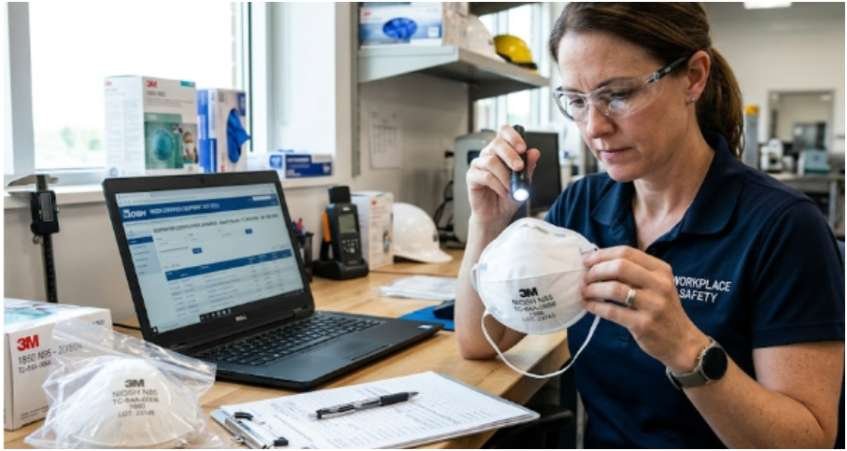
A respirator can look secure while leaking at the nose, cheeks, or chin. That is why qualitative vs quantitative respirator fit testing matters. Both methods confirm whether a specific facepiece seals to a specific worker, but they produce different evidence.
When I compare testing options, I start with the required protection level. Cost comes later. This approach prevents a convenient test from becoming a compliance problem.
Qualitative vs Quantitative Respirator Fit Testing: The Core Difference
Qualitative fit testing, or QLFT, is a sensory pass-or-fail assessment. The wearer reports whether a test agent enters the respirator. Quantitative fit testing, or QNFT, uses an instrument to measure leakage and calculate a numerical fit factor. OSHA defines QLFT as relying on the individual’s response and QNFT as numerically measuring leakage into the respirator.
| Factor | Qualitative testing | Quantitative testing |
| Result | Pass or fail | Numerical fit factor |
| Evidence | Taste, smell, or irritation response | Instrument measurement |
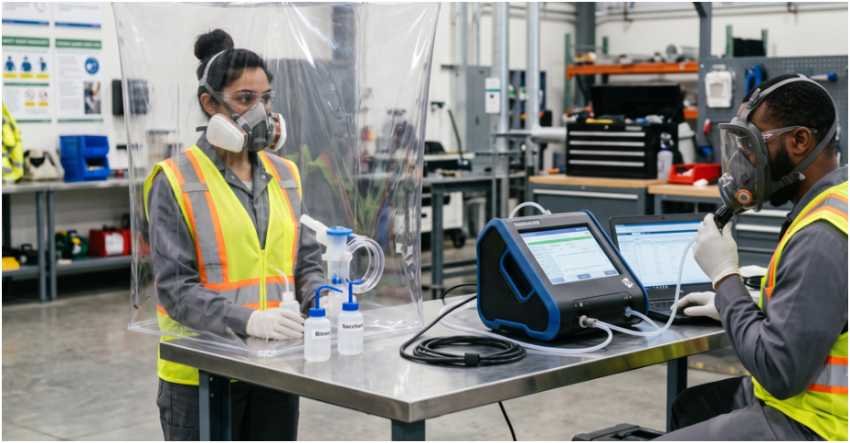
| Equipment | Hood, nebulizers, and test agent | Particle-counting or pressure system |
| Suitable use | Required fit factor of 100 or less | Objective data or higher fit factors |
| Main limitation | Relies on reliable detection | Requires specialized equipment |
The simplest summary of qualitative vs quantitative respirator fit testing is this: QLFT asks whether leakage was detected. QNFT measures the amount of leakage.
That distinction should guide every qualitative vs quantitative respirator fit testing decision. The method must match the respirator’s required performance rather than the employer’s preferred equipment.
How Qualitative Respirator Fit Testing Works
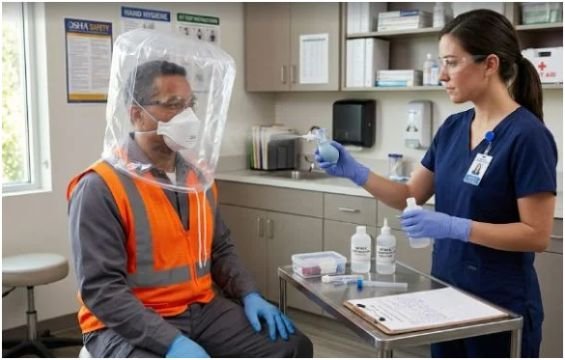
OSHA-Accepted Qualitative Test Agents
OSHA Appendix A includes four qualitative protocols:
- Isoamyl acetate
- Saccharin solution aerosol
- Bitrex solution aerosol
- Irritant smoke
Saccharin creates a sweet taste, while Bitrex creates a bitter taste. Isoamyl acetate has a distinctive banana-like odor. Irritant smoke produces an involuntary irritation response. NIOSH does not endorse or recommend the irritant smoke method, despite its inclusion in OSHA’s accepted protocols.
Before a saccharin or Bitrex test, the administrator must confirm that the worker can detect the agent. A worker who cannot taste the screening solution cannot use that protocol. The administrator must select another accepted agent or conduct QNFT.
What Happens During QLFT
The worker dons the respirator, adjusts it without assistance, and completes a user seal check. OSHA requires the selected respirator to be worn for at least five minutes before the fit test begins.
The worker then completes prescribed exercises. These may include normal breathing, deep breathing, speaking, moving the head, and bending. Detecting the test agent means the respirator has failed.
QLFT may only test negative-pressure air-purifying respirators that must achieve a fit factor of 100 or less. This requirement is more precise than saying qualitative testing is for N95s and quantitative testing is for full-face respirators. The required fit factor and operating mode determine the acceptable method.
How Quantitative Respirator Fit Testing Works
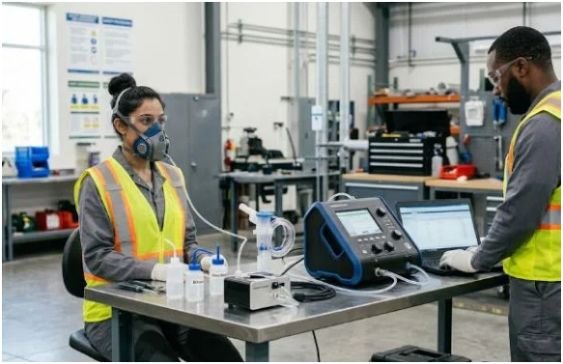
Understanding the Fit Factor
QNFT uses an OSHA-accepted instrument to produce a numerical result. A tight-fitting half facepiece must achieve a minimum fit factor of 100. A tight-fitting full facepiece must reach at least 500.
I use a simple calculation to make these scores easier to understand.
Suppose the particle concentration outside a respirator is 10,000 particles. The instrument measures 100 particles inside the respirator.
The calculation is:
10,000 ÷ 100 = a fit factor of 100
As a simplified concentration ratio, the inside measurement is 1/100 of the outside measurement, or 1%. A fit factor of 500 represents an inside-to-outside ratio of approximately 0.2%.
This calculation explains the numerical result. It does not replace OSHA’s assigned protection factors, exposure assessment, or required testing protocol.
Quantitative Testing Technologies
OSHA-approved quantitative approaches include generated-aerosol testing, ambient-aerosol condensation nuclei counting, and controlled negative-pressure testing.
Ambient-aerosol systems compare particles sampled inside and outside the facepiece. Controlled negative-pressure systems remove air from the facepiece and measure its leak rate under set pressure conditions.
Particle-counting tests use a sampling probe or approved adapter. A filtering facepiece may need to be punctured for the sampling tube. NIOSH states that a disposable respirator punctured for testing must be discarded afterward. Reusable respirators may use dedicated test facepieces or approved sampling adapters.
Choosing Qualitative vs Quantitative Respirator Fit Testing
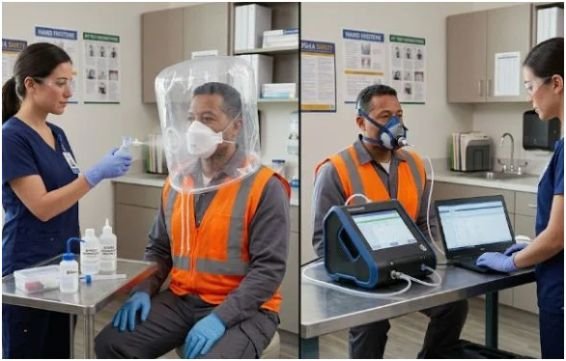
I use three questions when selecting qualitative vs quantitative respirator fit testing.
What Fit Factor Is Required?
Use QNFT when the required fit factor exceeds 100. OSHA requires a quantitative score of at least 100 for tight-fitting half facepieces and 500 for tight-fitting full facepieces.
QLFT cannot support a required fit factor above 100. Choosing QLFT solely because the equipment costs less may leave the employer using an unsuitable test.
Can the Worker Detect the Test Agent?
QLFT is unsuitable when the worker cannot reliably taste, smell, or react to the selected agent. Sensitivity screening is a mandatory part of the protocol, not an optional warm-up exercise.
A worker who cannot taste saccharin may still detect Bitrex. If no suitable qualitative agent works, QNFT removes dependence on the wearer’s sensory response.
What Records Does the Program Need?
QLFT provides a valid pass-or-fail result when correctly administered. QNFT adds a numerical score that can help an administrator compare models, identify weak fits, and maintain consistent records.
However, expensive equipment does not correct poor testing practices. An administrator must use an OSHA-accepted protocol, configure the passing criteria correctly, inspect the equipment, and record the tested respirator’s make, model, style, size, date, and result.
A Practical Workplace Example
Consider a fabrication shop using half-mask elastomeric respirators for a task that requires a fit factor no higher than 100. Either an accepted QLFT or QNFT may be appropriate, provided the complete respiratory protection program supports that selection.
The shop then introduces a process requiring a tight-fitting full-face respirator and a fit factor above the QLFT limit. QNFT becomes necessary. The worker must obtain a quantitative fit factor of at least 500.
The method changed because the required protection changed. It did not change because QNFT suddenly became superior in every workplace.
This example captures the main decision behind qualitative vs quantitative respirator fit testing: match the test to required performance, not habit, convenience, or equipment price.
Fit Testing Is Not a User Seal Check
A fit test is periodic and specific to the respirator’s make, model, style, and size. A user seal check happens every time a worker puts on a tight-fitting respirator. Passing an annual fit test does not prove that the respirator was donned correctly today.
Workers should learn how to perform a respirator user seal check by following the manufacturer’s instructions or an OSHA-recognized procedure. OSHA requires a seal check each time a tight-fitting respirator is worn.
Workers must also remain clean-shaven wherever hair crosses the facepiece sealing surface. Corrective glasses, goggles, protective clothing, and other equipment cannot interfere with the seal.
This distinction is central to qualitative vs quantitative respirator fit testing because neither method verifies every later donning.
When Retesting Is Required
OSHA requires fit testing:
- Before the respirator’s initial workplace use
- Whenever the make, model, style, or size changes
- At least once every year
- When physical changes may affect the face seal
- When the worker reports that the fit has become unacceptable
Relevant physical changes include facial scarring, dental work, cosmetic surgery, and noticeable weight changes.
Annual testing has a practical basis. A three-year NIOSH study involving 229 initial participants found that the predicted risk of unacceptable fit reached 10% after one year. It increased to 20% after two years and approximately 25% after three years.
A familiar respirator is not proof of a continuing seal.
Frequently Asked Questions
1. Is qualitative or quantitative fit testing required for an N95?
Either method may be used when an OSHA-accepted protocol applies and the respirator only needs a fit factor of 100.
2. Can a full-face respirator be qualitatively fit tested?
It may be possible in limited applications, but QLFT cannot support a required fit factor above 100. Full-face applications requiring the quantitative threshold must use QNFT.
3. What is the minimum passing quantitative fit factor?
OSHA requires at least 100 for a tight-fitting half facepiece and 500 for a tight-fitting full facepiece.
4. How often is qualitative vs quantitative respirator fit testing required?
Qualitative vs quantitative respirator fit testing is required before initial use, after relevant facepiece or physical changes, and at least annually.
Pick the Test, Not the Shortcut
My choice in qualitative vs quantitative respirator fit testing depends on the required protection. I favor QLFT for straightforward programs operating within its legal limit. I favor QNFT when higher fit factors, numerical measurements, or stronger comparison records are necessary.
Treat qualitative vs quantitative respirator fit testing as a worker-protection decision rather than a purchasing decision. Confirm the hazard assessment, respirator type, operating mode, and required fit factor first. Then choose the OSHA-accepted method that can reliably prove the selected respirator fits the worker.