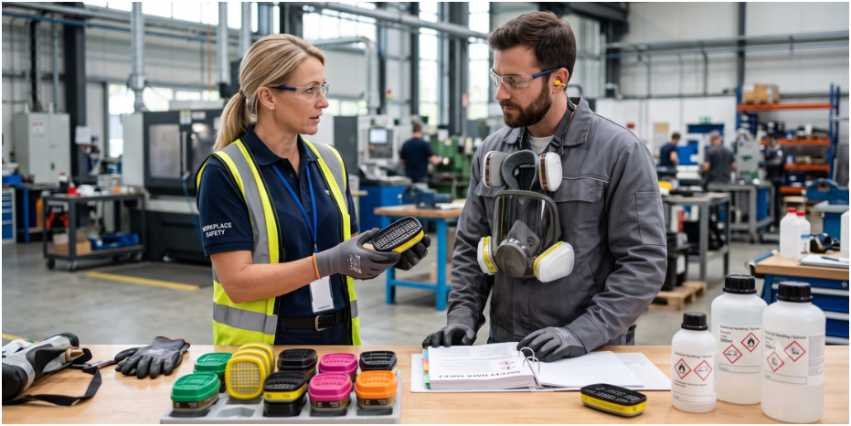
The wrong cartridge can look right, fit the facepiece, and still offer no protection against the chemical in the air. When I assess how to choose respirator cartridges for workplace chemicals, I start with the contaminant and measured exposure—not a familiar color or product number.
Cartridge selection must sit inside an OSHA-compliant respiratory protection program. Employers must evaluate hazards, select suitable NIOSH-approved equipment, provide medical evaluations, fit test workers, and train them before required respirator use.
Start With the Hazard, Not the Cartridge Color

Read the SDS With the Exposure Assessment
Review Sections 2, 3, and 8 of the Safety Data Sheet. Identify hazardous ingredients, physical form, exposure limits, and recommended controls. Then compare those details with air-monitoring results.
An SDS recommendation alone does not prove suitability. Confirm the airborne concentration, work duration, temperature, humidity, and breathing demand. OSHA requires employers to evaluate respiratory hazards before choosing equipment.
Classify the exposure as particles, gases, vapors, or a combination. Dust, mist, welding fumes, solvent vapor, chlorine, and ammonia require different forms of protection.
Decide Whether Cartridges Are Allowed
Air-purifying respirators remove selected contaminants from surrounding air. They do not supply oxygen.
Never use them in an oxygen-deficient atmosphere, an immediately dangerous to life or health atmosphere, or an area with unknown contaminants or concentrations. Those conditions require an appropriate atmosphere-supplying respirator.
This is the first stop point in how to choose respirator cartridges for workplace chemicals. An unknown hazard is a reason to stop entry, not guess which cartridge might work.
Match the Cartridge to the Exact Hazard
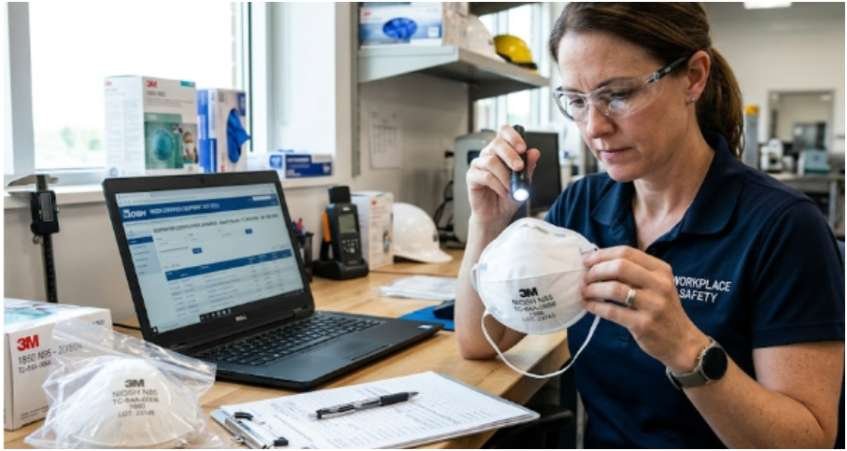
Use the NIOSH Approval Label
I use a label-before-color rule. The cartridge’s NIOSH approval label must identify the applicable gas, vapor, or particulate category. Color coding is only a secondary identification aid.
Verify the complete assembly in the NIOSH Certified Equipment List. The cartridge and facepiece must be approved together.
Common U.S. label colors include black for organic vapor, white for acid gas, yellow for organic vapor plus acid gas, green for ammonia or methylamine, olive for multi-gas, and magenta for P100 or high-efficiency particulate filtration.
Exact contaminant coverage still depends on the printed approval label.
Add Particulate Protection When Needed
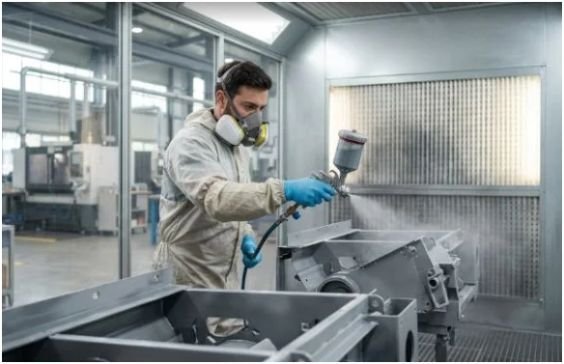
A gas or vapor cartridge does not automatically filter particles. Spraying, sanding, welding, and handling powders may create combination exposures.
Use an approved combination cartridge or particulate prefilter installed as directed. Organic-vapor plus P100 protection is suitable only when the label covers the hazards and exposure stays within the respirator’s limits.
Do not assume every painting task needs the same cartridge. A coating may contain organic solvents, acid gases, ammonia compounds, isocyanates, metal pigments, or hazardous spray mist. Each ingredient must be evaluated.
Quick Respirator Cartridge Color Guide
| U.S. label color | General category | Typical examples | Critical warning |
| Black | Organic vapor | Toluene, xylene and many solvents | Check every chemical on the approval label |
| White | Acid gas | Chlorine, hydrogen chloride and sulfur dioxide | Some gases have special use limits |
| Yellow | Organic vapor plus acid gas | Mixed solvent and acid-gas tasks | Not a universal chemical cartridge |
| Green | Ammonia or methylamine | Refrigeration and fertilizer work | Confirm the concentration and cartridge model |
| Olive | Multi-gas and vapor | Several identified gases or vapors | “Multi-gas” does not mean every chemical |
| Magenta | P100 or high-efficiency particles | Dust, mist and fumes | Does not protect against gases or vapors alone |
Color helps workers identify a cartridge family. It cannot replace the NIOSH approval label, manufacturer instructions, or exposure assessment.
Brown should not be treated as a general U.S. multi-gas code. Some international systems and product lines use different color conventions, making the approval label even more important.
Check Protection Limits and Fit
Confirm the Maximum Use Concentration
The respirator must protect at the measured concentration. Maximum use concentration is generally the assigned protection factor multiplied by the exposure limit, unless a lower regulatory or manufacturer limit applies.
A properly fitted half-mask air-purifying respirator commonly has an assigned protection factor of 10. However, that does not automatically allow every chemical exposure at ten times its occupational exposure limit.
Cartridge limits, substance-specific OSHA standards, poor warning properties, and IDLH thresholds may require a full-face respirator, powered respirator, supplied-air respirator, or self-contained breathing apparatus.
Verify Compatibility and Fit Testing
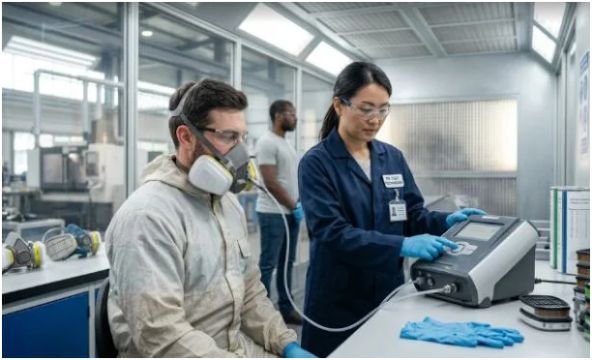
Use cartridges approved for the selected facepiece. Complete the required medical evaluation, training, and fit testing before use.
OSHA requires fit testing before initial use, after changing facepieces, and at least annually. Retesting is also required after physical changes that may affect the face seal.
Review OSHA respirator fit testing requirements for employees before assigning equipment. Workers must also perform a user seal check each time they put on a tight-fitting respirator.
A successful annual fit test does not guarantee that a respirator has been positioned correctly during every shift.
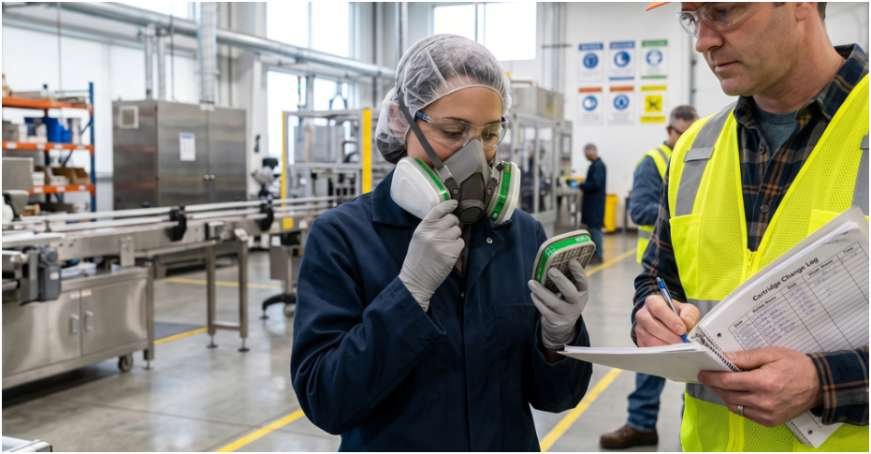
Create a Cartridge Change Schedule
Never use odor as the replacement signal. Odor sensitivity varies, workers can become desensitized, and some chemicals have poor warning properties.
OSHA requires a written change schedule for gas and vapor cartridges unless an approved end-of-service-life indicator is used. The schedule must document the information used to establish the replacement interval.
Service life changes with:
- contaminant concentration;
- humidity and temperature;
- worker breathing rate;
- cartridge capacity;
- work intensity; and
- daily exposure duration.
Manufacturer software can support a conservative interval. The 3M Select and Service Life Software estimates cartridge life from entered workplace conditions.
Store cartridges sealed away from contaminated air. Mark opening dates, total use time, and discard deadlines. Replace damaged, wet, contaminated, or hard-to-breathe-through cartridges sooner.
A cartridge used for only two hours may still lose service life while stored incorrectly. Captured vapors can move through the sorbent bed after use, especially when cartridges remain exposed to workplace air.
Worked Workplace Example
Consider a worker who applies a toluene-based coating and later sands it. Monitoring confirms known, non-IDLH concentrations within the respirator’s maximum use concentration.
The coating creates organic vapor. Sanding creates particulate. My selection sequence is:
- Confirm every hazardous ingredient through the SDS and exposure assessment.
- Select a NIOSH-approved organic-vapor cartridge covering the identified vapor.
- Add an approved P100 component for the sanding particulate.
- Verify the cartridge and facepiece combination in the approval documents.
- Fit test the worker and require a seal check at every use.
- Establish a documented change schedule using measured conditions and manufacturer data.
This shows how to choose respirator cartridges for workplace chemicals without relying on a job title. Two painting tasks may involve entirely different mixtures, concentrations, and application methods.
Frequently Asked Questions
1. Can one multi-gas cartridge protect against every workplace chemical?
No. It covers only the contaminants listed on its NIOSH approval label and remains subject to concentration and use limits.
2. Which respirator cartridge should I use for paint spraying?
Identify every coating, reducer, catalyst, and spray particulate first; many tasks require organic-vapor plus particulate protection, while some chemicals require supplied air.
3. How do I know when an organic-vapor cartridge is exhausted?
Follow the written change schedule or approved end-of-service-life indicator; never wait for odor, taste, or irritation.
4. Can I Choose a Respirator Cartridge From the SDS Alone?
No. Combine SDS details with air monitoring, exposure limits, respirator APF, manufacturer instructions, and the NIOSH approval label.
Pick by Evidence, Not by Paint Color
The safest answer to how to choose respirator cartridges for workplace chemicals is documented proof: identified chemicals, measured exposure, permitted respirator, approved cartridge, adequate protection, verified fit, and a conservative replacement schedule.
Use color as a quick check. Let the approval label, exposure assessment, manufacturer instructions, and written respiratory protection program make the serious decision.